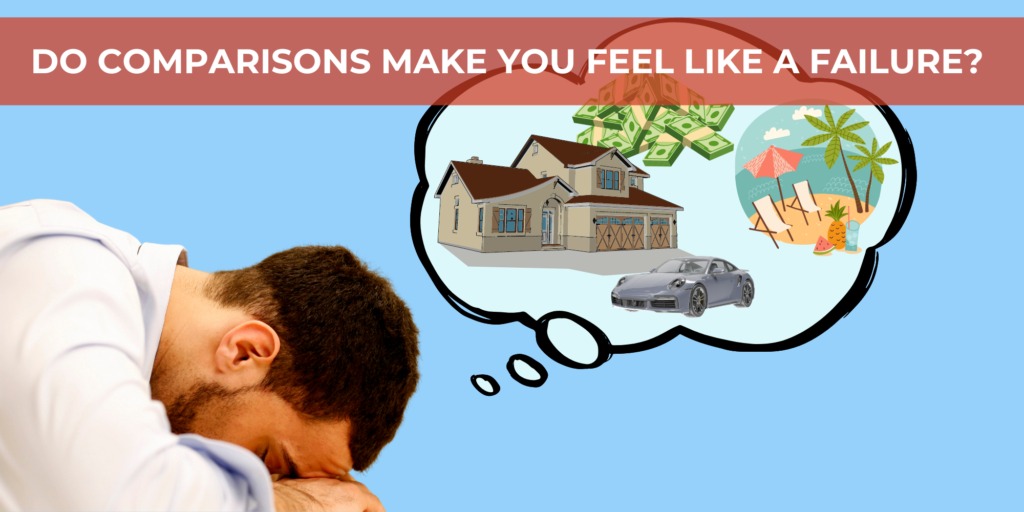
The world is a connected and social place. We’re exposed to the lives of a wide variety of people; friends, colleagues, neighbours and celebrities.
Even more so through the use of social media, television, blogs and podcasts. We’re inundated with details of their lives, especially their successes, their nice cars, luxurious lifestyle, beautiful partner and carefree, perfect existence.
Consequently we compare ourselves with them and feel like a failure.
But stop for a moment and consider these comparisons. We don’t know the truth of their existence. The successful life they’re living may be a lie, a happy façade of a miserable existence.
Whatever the truth these comparisons make us feel down, and dissatisfied with our own life. So, how can we limit these comparisons which make us feel like a failure?
Here are 5 methods which I’ve tried and tested, 2 which I’ve adopted and made a habit. Which has led to a positive change with regards to how I understand success and comparisons I make with others.

#1. Reduce or even stop your use of social media
When social media became popular I found that I’d constantly check it, Facebook was my weakness.
But all I ever saw were people doing better than me, better cars, nicer holidays…
It became a habit, one which made me feel bad, so I went cold turkey. Quitting social media gave me back my confidence, no longer did I compare myself against unrealistic expectation.
Although this is anecdotal it is supported by Scope, who surveyed 1500 social media users, almost two thirds felt that sites like Facebook made them feel inadequate.
You don’t have to give it up completely but try limit your exposure. Also, choose what you expose yourself to, educational and empowering content should replace materialistic and boastful content.
#2. Recognise the positives in your life by practicing gratitude
This is acknowledging what’s good in your life. When I first discovered the practice of gratitude, I did ask myself is it worth the effort?
In my opinion YES, it’s simplicity and the change it can foster are worth it. If you want to give it a go a common method is to keep a journal.
Known as journaling, you write down the things you’re thankful for in life, like a loving wife, a stable job or being in good health.
It can include small things that went well during your day; a nice cup of coffee, a friendly smile from a stranger or a traffic free journey – it’s about focusing on and being grateful for the positive things.
I practice gratitude twice a day whilst brushing my teeth, it helps relieve boredom and I start and end the day in the right frame of mind.
Unfortunately, our busy lives mean that we frequently overlook the positive. The things that bring us joy and make life worth living. Unhealthy comparisons also diminish and invalidate these positives.
The practice helps to reduce the negative impact of comparisons. In addition it teaches you to recognise the positive things in life, improves self-esteem and many other benefits.
#3. Recognise and celebrate all of your successes
Not only do we criticise ourselves for every little failure, but we also neglect our successes.
Making comparisons with people who we perceive to be more successful can be disruptive to our wellbeing. The comparisons are often unfair and uninformed.
We don’t all have the same start in life or the same resources, we may be comparing ourselves to someone who’s had incredible luck or whose success is a fabricated lie.
Additionally when we compare ourselves with successful people, we only see part of the story, we don’t see the hard work put in and the sacrifices they made.
So, celebrate all your successes, big or small, such as: getting through another stressful day at work, helping your child with their homework…anything you have a hand in which results in a positive outcome.
#4. Use the power of comparisons to empower yourself
In 1954 Leon Festinger proposed something called social comparison theory. A theory which suggests people assess their value by comparing themselves to other people. 1
It doesn’t take much effort to believe this, as we’ve experienced it since we were able to comprehend the world. These comparisons are often negative, but comparisons can be utilised in a positive way.
Therefore to demonstrate this we need to understand that there are upward and downward social comparisons.
Upward is when you compare yourself to someone you believe is better than you2, for example someone who’s performing better than you at work.
Used positively you can identify what they do, and how they do it, with the aim to learn how to achieve similar results. However, be aware that comparisons can lead to envy, dissatisfaction and other negative emotions and behaviours.
In contrast a downward comparison is when you compare yourself to work colleagues, who are doing worse than you. This comparison can boost self-esteem3, but be cautious that it doesn’t lead to complacency.
#5. Be realistic about what success means to you
Feeling like a failure because of the comparisons you make with others will lead you away from a fulfilled and happy life.
A life which you may already be living, but at the time being ignorant of the fact. When comparing yourself to others ask yourself:
Is what they have worth the sacrifice?
Would what they have really make me happy?
Is what they have really my idea of success?
These 3 questions can help identify your values and what you want in life.
For example, your neighbour has on their driveway a brand new, top of the range £60,000 car. Would you owning this car be worth the sacrifices? Including monthly payments, working endless hours and missing family time.
Think about what really matters in your life and what success means to you. Set goals which lead to a fulfilled life, not goals which focus single-mindedly on fulfilling materialistic wants.
Comparing yourself to others and their perceived success can lead you down a road of sadness and disappointment.
A road I experienced for a short period. However good or bad things are, there’ll always be people doing better and worse than you.
Reducing my social media use and being grateful for what I have helped me to be more positive and feel less of a failure.
Also, I celebrate my wins. So, don’t dismiss your wins because you perceive them as insignificant in comparison to what other people achieve.
With the right perspective the use of comparisons either upward or downward can motivate you or boost your self-esteem.
Try to identify what will make you happy. Working incredibly hard and making sacrifices may lead to a life that you find shallow and unfulfilling.
Experiment with the 5 methods and find which work for you. Each has value and can help you think differently about the comparisons you make.
However, if none help, and making comparisons has a real impact on the quality of your life, seek professional advice. Either speak to a healthcare professional or find a therapist or organisation who can provide the advice or help you need.
References
- Kendra Cherry, MSEd. (Updated 2024) Social Comparison Theory in Psychology. https://www.verywellmind.com/what-is-the-social-comparison-process-2795872. (Accessed 17th September 2024) ↩︎
- Wang JL, Wang HZ, Gaskin J, Hawk S. The mediating roles of upward social comparison and self-esteem and the moderating role of social comparison orientation in the association between social networking site usage and subjective well-being. Front Psychol. 2017;8:771. doi:10.3389/fpsyg.2017.00771 ↩︎
- Amoroso, D. M, & Walters, R. H. (1969). Effects of anxiety and socially mediated anxiety reduction on paired-associate learning. Journal of Personality and Social Psychology, 11, 388–339. ↩︎