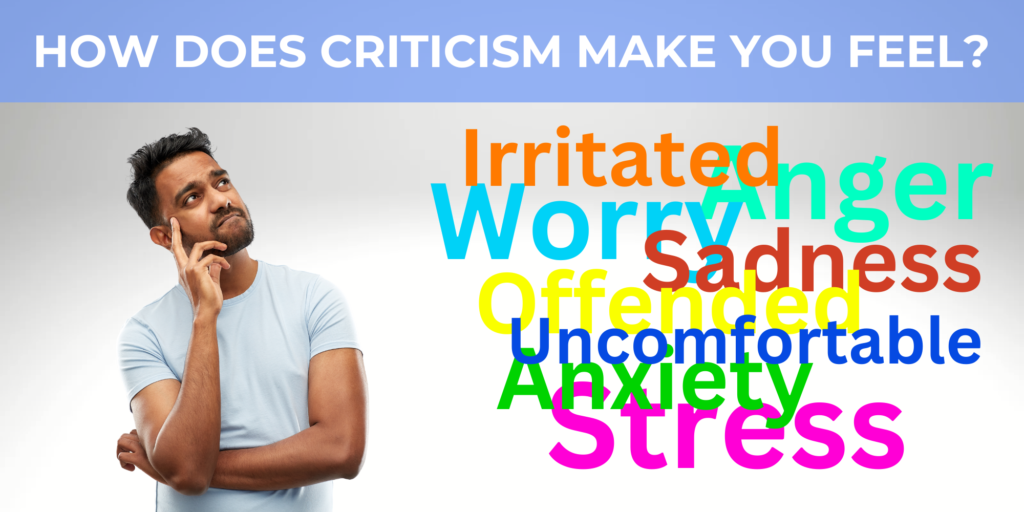
We develop most in life when things push us out of our comfort zone. Criticism is one of those things. Taken to heart it can ruin your day and damage your self-confidence. Here are 3 methods to help you better deal with criticism.
Personally, I’ve received lots of criticism, both at work and in my personal life. Consequently, I used to take criticism to heart, which had an impact on my confidence.
These strategies have helped me deal better with criticism. Helping me to understand what criticism is and the intention behind it.
They worked for me. Try them, they may help you deal with criticism in a more positive way.
Understand Criticism To Better Deal With It
A simple description of criticism is when someone expresses a fault or bad quality of someone else.
This is the common view of criticism, it can be a hard thing to deal with. It’s viewed negatively but it can be a positive source of information and motivation.
Which is why we need to respond calmly and explore its validity.
A criticism could be well meant, but poorly executed. Causing the recipient unintended upset. Essentially poorly executed feedback.
The purpose behind feedback is to help us learn and grow, whilst criticism normally has a darker purpose. The difference between feedback vs criticism is quite clear, but there can be crossover and blending of the two.
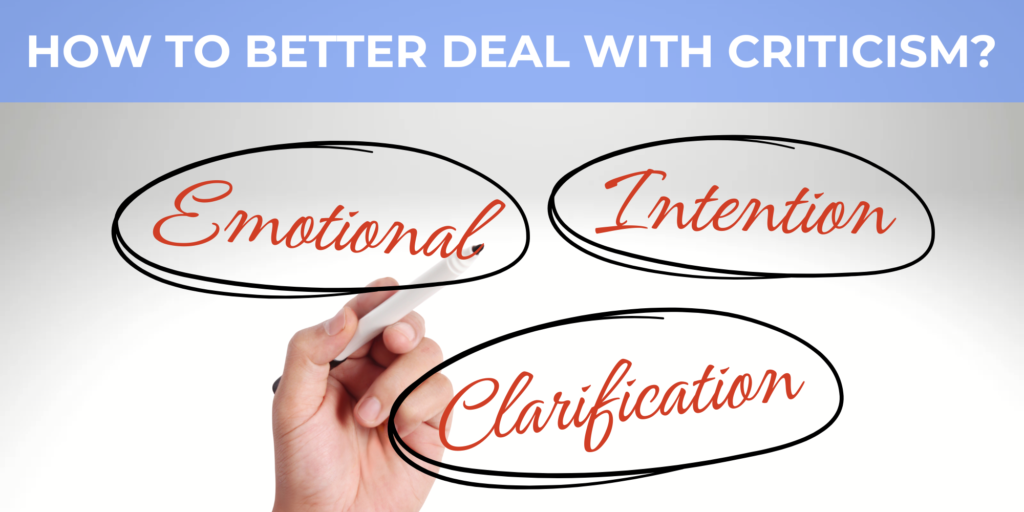
Strategies To Better Deal With Criticism
Avoid becoming emotional when receiving criticism
When someone is criticising you the worse thing you can do is become openly emotional. Because this can be unprofessional, result in the outcome intended (upset) or result in personal disappointment in your lack of control.
Scenario: The workplace
Your line manager criticises a report you completed. It seemed to be criticism rather than constructive feedback.
What would the best response be?
Thanking them, asking them for clarification of the errors and correcting them if the criticism is correct. If not, ask for further clarification or seek advice if you feel you’re being treated unfairly.
Alternatively, your response could be to get enraged or become upset. Telling them that they’re wrong and blaming them, for example being given too tight of a deadline.
Response 1 would give off a professional image, require them to prove their criticism and give you time to reflect and correct the errors.
Response 2 would lead to undesirable consequences, office gossip, appearing unprofessional and reactive. Also, you would probably be disappointed in yourself.
It’s useful to remember that criticism is:
- Temporary so take the criticism and move on, upsetting things pass
- Criticism is only words, but they have an impact emotionally which can impact on your physical health
- Often inaccurate as they may have made a mistake, like criticising the wrong person
- Easily misinterpreted for example a lecturer may criticise an essay you’ve done, they’re only specifically criticising the work, not you.
Don’t take criticism to heart, be questioning of its validity. Misunderstandings occur and people can be emotional, which can cause them to say hurtful and inaccurate things.
Consider the intention of the person giving the criticism
Who is giving the criticism? The motives people have for criticising are complex, and can have either a positive or negative intent.
For example, if you go clothes shopping with a friend and they criticise an item of clothing you try on, their criticism could be:
Negative – given for the wrong reason, they think you look great and they envy the way you look. They say the outfit looks horrible, with the intention to stop you buying it, and to improve their mood and upset you.
Positive – your friend thinks the fit of the item doesn’t suit you. Their intention is to help you pick the right outfit and be a good friend.
This highlights that we should be cautious, to think about why the person is criticising us and what their motive is.
Is the person giving the criticism qualified? I know only the basics of car repair, so when I go to the garage for a repair would I criticise the job the mechanic does?
No, because it’s not my area of expertise. But if I criticised how he worked on the car would it have an impact on him? Probably not, because he knows he’s the expert. and I’m just an annoying customer.
This is true for any criticism you receive. A teacher giving you criticism is likely to mean it to be constructive and valuable. Conversely, a peers criticism may be less valuable and have a different motive.
Don’t assume criticism is given for unethical reasons, but be alert for:
- Frenemies who are people who pretend to like you but secretly wish you harm
- Bullies who enjoy seeing others suffer, making themselves feel more powerful
- Jealousy as a negative emotion because they believe you are doing better than them
- Negative people, because these people can be hard to deal with, they struggle with their own lives, so don’t hesitate to spread their negativity to others. There are ways to better deal with negative people.
A method to discover the intention of the person giving the criticism is to put yourself in their shoes.
This not only helps you identify their motives, but you can help empathise with them. They could be a good person, who has issues. Someone you need to have an honest chat with.
Seek clarification of criticism to identify its value
Receiving criticism can be harsh, some criticism may be given with the best of intentions. It may be constructive or destructive.
Whichever it is we must seek clarification, because often the thing being criticised is undefined.
For example if you give a presentation and your boss tells you it wasn’t very good, but gives no specifics, you get nothing useful from their feedback.
There’s no clarity, your boss may not even be aiming the criticism at you. The criticism could be your colleagues input which was out of your control. This is why clarifications important.
In an ideal world, your boss would consider how the presentation went and give you constructive feedback, rather than criticise your presentation.
However, people are not always adept at identifying how their comments impact others. A simple throwaway comment can cause friction and upset.
In this example we would want to clarify our bosses comments. By asking appropriate questions:
- Could you clarify what was wrong with the presentation?
- Can you give me an example so I can narrow in on the problem?
- What do you think I could have done differently?
- Is there training or anything which might help me next time?
- How can I demonstrate to you any progress I’ve made?
Seeking clarity helps us better deal with criticism, it helps us identify its value. If it has none you can ignore it, and move on without any further concern.
However, if it has value you can use it to instigate personal development.
Additionally, clarifying criticism helps the person giving it. It may highlight to them that they need to improve how they give feedback. To be able to provide feedback which is more specific and structured in a more professional way.
Summary…To Better Deal With Criticism
Dealing with criticism is challenging, but it offers an opportunity for growth. By staying calm, considering the intention behind the criticism, and seeking clarification we can better deal with criticism.
Remember, criticism isn’t always a personal attack. It’s simply from the critic’s perspective and could hold valuable insights.
The next time you face criticism, think before reacting. Don’t let emotion get the better of you. Staying calm makes you look professional, strong and resilient.
If you’ve found these strategies helpful, let me know in the comments! Any constructive criticism can only help move things forward in a positive way.
How will you deal with the criticism you receive? Will you let it destroy your self-confidence or will you take it as an opportunity to grow?